Project Description:
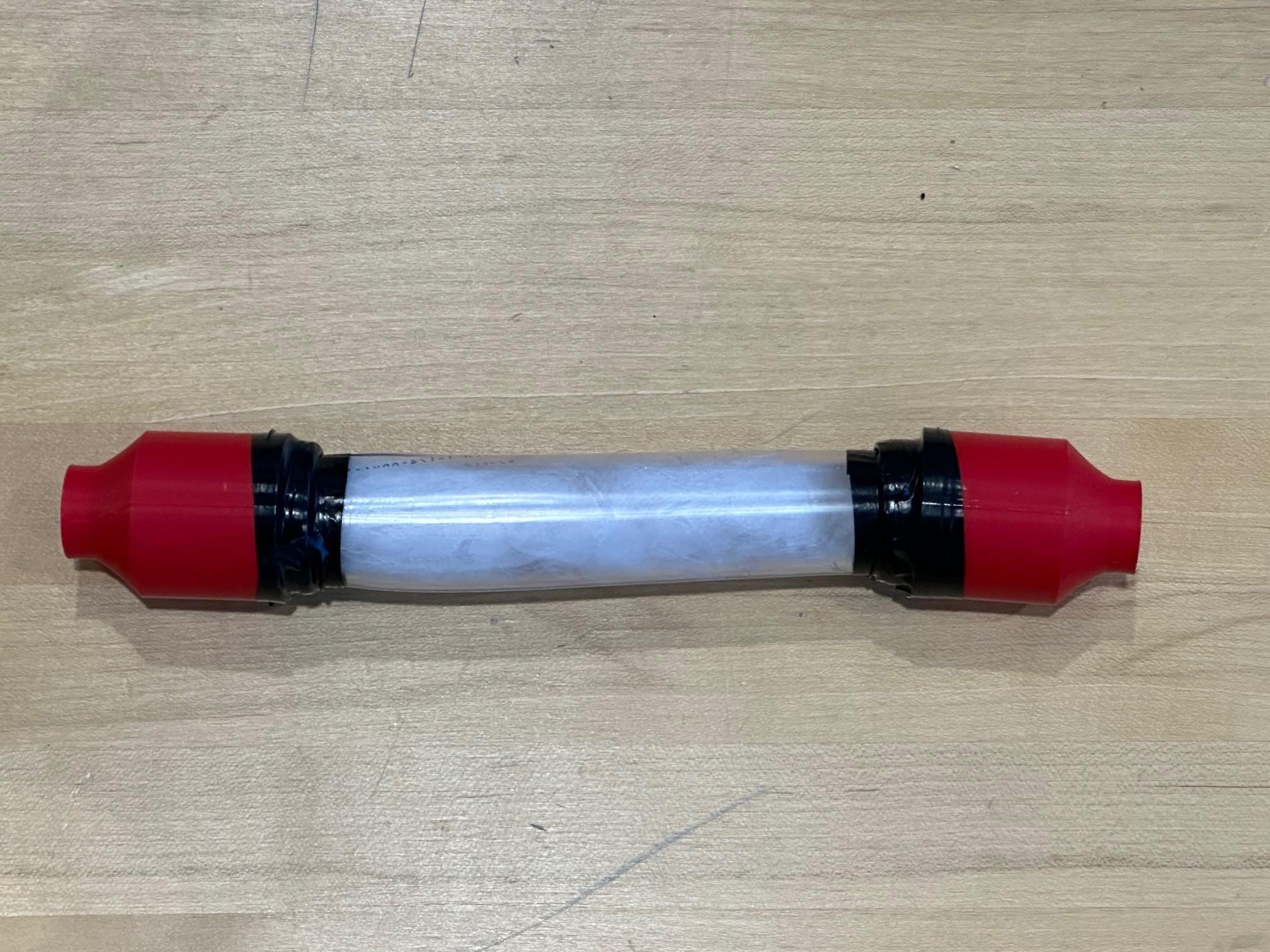
While hemorrhaging remains one of the leading causes of death from traumatic injury, it is still quite limited in terms of available interventions. Currently, the most widespread and standard of care treatment for hemorrhagic injuries is by way of allogenic blood transfusions, a limited resource that gets continually bottlenecked by supply chain, storage, and accessibility. This project aims to design and develop a compact blood filter able to sanitize blood for safe autologous retransfusion. Using affinity-based filtration with polymyxin B immobilized on a mesh, our filter will selectively remove bacteria and endotoxins while preserving red blood cells. Through iterative prototyping, we evaluated multiple tube geometries and mesh densities using benchtop flow experiments. The final geometry chosen was a tube of 8 in length and 1 in inner diameter with a mesh surface area of 4 ft2. The flow rate and final geometries were evaluated in a fluid dynamics model with a final flow rate of 49.6 mL/min, 3 minute residence time, and shear stress of 0.0045 Pa. Testing of bacterial binding to an aqueous solution of polymyxin B revealed that a 10^6 times greater concentration of molecules to CFU is necessary for complete binding. Additionally, a residence time of at least 5 minutes is required for the system to plateau near maximal bacterial killing. Future testing using blood will be necessary to confirm blood clotting behavior. This device promotes equitable access to care by providing a low-cost, portable solution that can be used in resource-limited or emergency environments where donor blood is unavailable. Overall, this system has the potential to improve survival outcomes by enabling rapid, on-site blood filtration and reuse in critical situations.